
Why your expertise isn't showing up
Here's an example business Arjita Sethi uses in class. Rosa runs BrightPath Tutoring in Oakland. She has years of experience and a lovely homepage. A parent asks ChatGPT, "My 9-year-old is falling behind in math. Should I get a tutor or try an app first?" AI answers by quoting a different tutor, Lakeside Learning, because Lakeside wrote a blog post answering that exact question. Rosa never did.
People have stopped typing keywords like "tutoring Oakland." They ask full questions about their actual situation. The businesses that answer those questions get quoted, whatever their size.
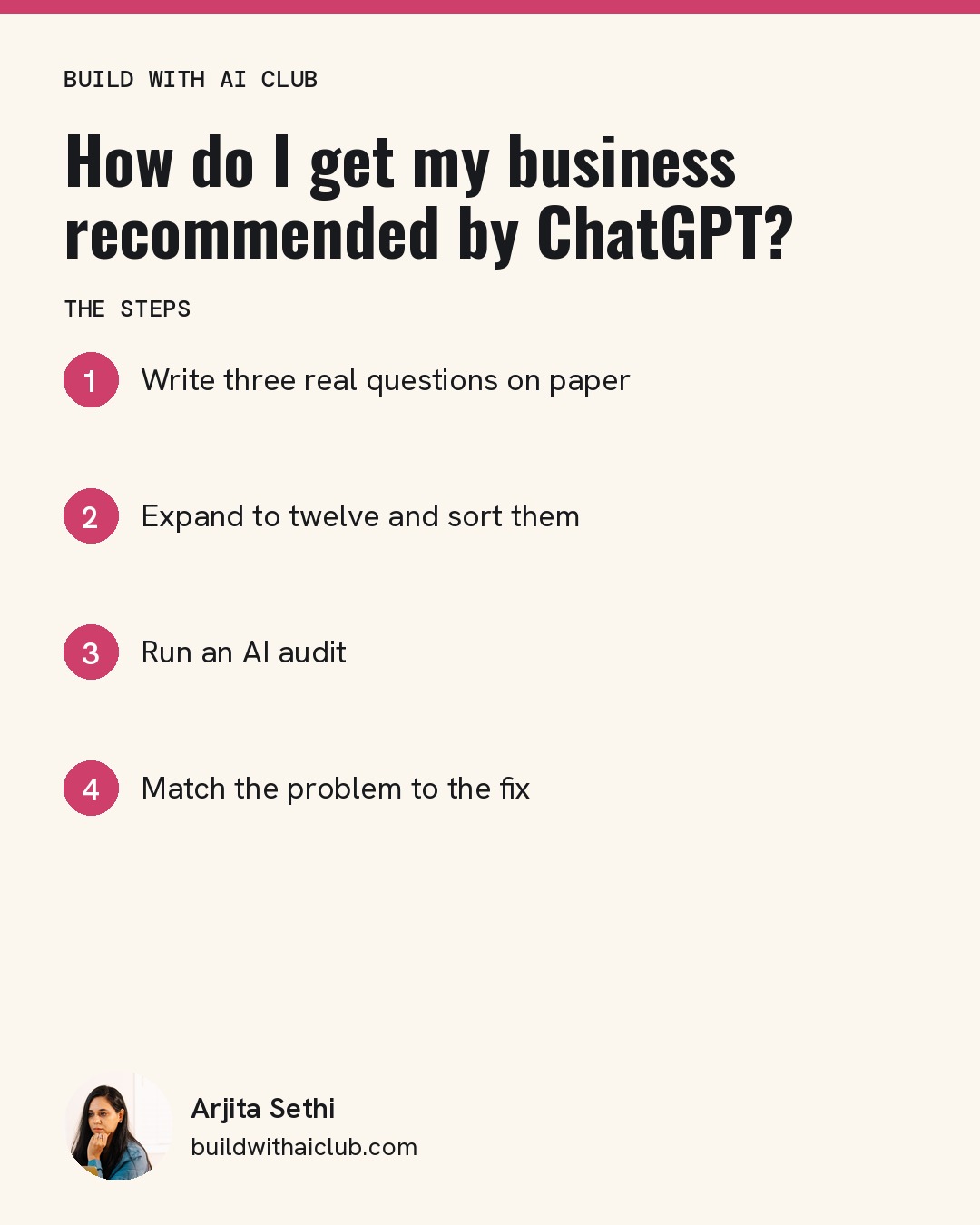
Step 1: Write three real questions on paper
Arjita starts this exercise with pen and paper. Think of one real customer and write down three questions they asked you before they ever paid. Use their exact words, even if they were messy. If you don't have customers yet, write what you expect your first customer to ask.
Exact words matter. When Arjita was building her edtech company, she expected parents to praise the math and language content. Instead they told her, "My kids move around when they use your application. They're not screen zombies." She would never have chosen "screen zombies" herself, and that phrase became the campaign that built a pipeline of 40,000 people.
Step 2: Expand to twelve and sort them
Paste this into your AI of choice:
"I run [business]. Here are 3 questions real customers ask me before buying: [your 3 questions]. Write 12 questions my customers would type into ChatGPT or Claude, in their words, not mine. Sort them into learning, comparing and deciding questions. Star the 3 with the strongest buying signal."
The three moods tell you what each question is worth:
- Learning ("Why does my kid freeze on word problems?") builds long-term trust.
- Comparing ("Is a tutor worth it, or should we try an app first?") reaches people close to buying.
- Deciding ("Best math tutor in Oakland for a 9-year-old") is the strongest buying signal.
Step 3: Run an AI audit
Open an incognito window so the AI has no cookies or history about you, and ask what it knows about your business: what you do, who you're for, what people say, and where it learned that. Ask it to say so if it isn't sure and to list its sources. Then ask who it would recommend instead, and why.
Step 4: Match the problem to the fix
Arjita sees four results again and again:
- It has never heard of you. Publish one clear page that answers your three starred questions.
- It knows you exist but can't say why anyone picks you. Replace vague lines like "we help change the world" with specifics.
- It quotes old prices, services or locations. Update the source.
- It names a competitor. Study why that competitor gets recommended.
Make your website the source of truth
Social profiles help, and your website still has to hold the most accurate answer. Arjita learned this herself when a link on one of her social profiles broke. The person went to her website instead, found what she needed and bought a training there.
Who this is for
This is for small business owners, service providers, founders and marketers who want to show up when customers ask AI for advice. You don't need to be a large company or a software startup, and you don't need to code.
Next step: Bring your three questions to the next free Build with AI Club Wednesday session, November 18, 6 to 7 PM PT, at SHACK15 in San Francisco or online. https://luma.com/build-with-ai-club